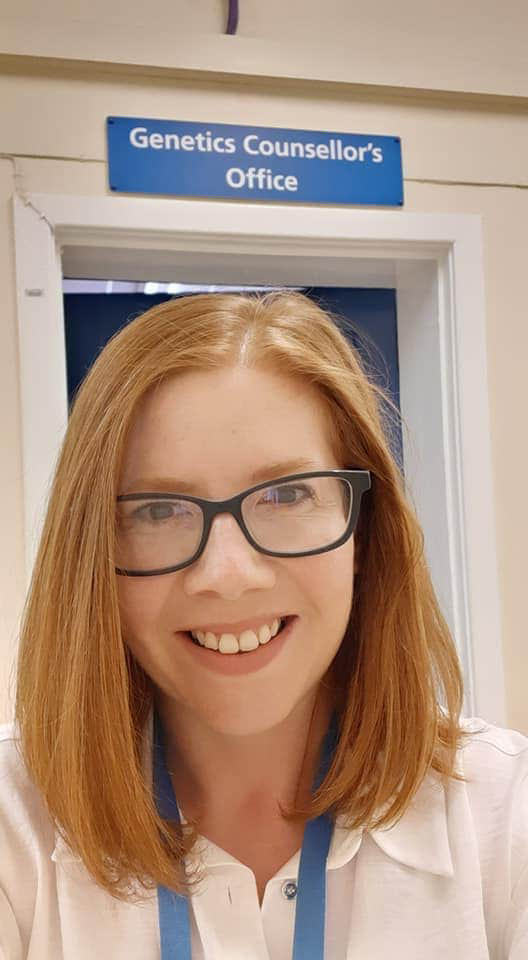
Beckie tells us how people like her can help women who have been diagnosed with cancer and their families.
What is a genetic counsellor?
Genetic counsellors see a variety of patients but most of those I see in clinic have either been diagnosed with cancer or have a family history of cancer. My job is to assess whether their diagnosis or family history could be caused by an inherited predisposition, or just by bad luck, or other lifestyle or environmental factors. Most cancers are caused by environmental factors; like smoking increasing the risk of lung cancer, or UV exposure (from the sun) increasing the risk of skin cancer. But a small amount of cancers are caused by an inherited genetic change which increases the risk of a tumour. For some families we are able to offer genetic tests to try to find the cause of the cancers in their family. We offer advice on screening and lifestyle options that can help reduce their risk.
What have genes got to do with it?
Ovarian cancer is a relatively rare female cancer – less than 2% of women will be diagnosed with an ovarian tumour in their life. But it can actually run in families, and can be linked with other cancers in a family. For example, ovarian and breast cancer can be linked in a family when there is an alteration in certain genes (BRCA1 or BRCA2). Ovarian, womb and bowel cancer can be linked in a family, when there is a gene change that causes Lynch syndrome. There are also other rare gene changes associated with ovarian cancer in a family.
Why is genetic counselling useful?
Genetic testing can help tell someone why they developed cancer, as well as give us information about their future risk of cancer. It can also help give information to the rest of the family. There might be genetic testing that relatives can access, or screening advice. For women with ovarian cancer, genetic testing can now even guide their treatment. New drugs have been approved in the last few years that specifically work if a woman has a gene change in the BRCA1 or BRCA2 genes.
How can you access it?
We accept referrals from any medical professionals, so if you have a family history of cancer (on your mum’s or dad’s side) it’s worth asking your GP, nurse or hospital doctor about whether you should be referred to your local clinical genetics department.
CASE STUDY.
How it works: Anne and her daughter Zoe
Anne was referred to our clinic by the gynaecology team after she had been diagnosed with ovarian cancer in her fifties. The gynaecology doctor had taken her consent to do a genetic test on her ovarian tumour to see if she had a BRCA1 or BRCA2 gene change. The results showed that her tumour did have one of these gene changes, in the BRCA1 gene. This meant that she could access ‘PARP inhibitors’, a special medication that works on tumours with these gene changes. Sometimes that gene change can happen randomly in a tumour, or it can happen because the person carries a gene change in the BRCA1 gene that they have had their whole lives. When we tested Anne’s blood sample, we found that she did carry a BRCA1 change in her blood. This means she inherited this from either her mum or her dad.
We wouldn’t know for sure until we tested them with a blood test.
My job as her genetic counsellor was to explain these results, and help her understand and also come to terms with this result, and what it means for her. Even though Anne had ovarian cancer, I referred her for breast screening. This is because we know that women who have a BRCA1 gene change have a high risk of breast cancer. Anne was concerned about her daughter Zoe, who was in her twenties. I suggested that Zoe speak to her GP and get referred to us, I gave Anne a letter that she could give to Zoe. A few months later Zoe came to my clinic at the hospital. Even though Zoe knew some information about the BRCA1 gene change that she had read online, I went through with her how genes work, and what happens when a woman has that gene change. Because we knew that her mum carried this gene change, Zoe had a 50%, or one in two, chance of carrying the same gene change. There was no way of knowing by looking at her, the only way to be sure was to do a blood test.
Zoe knew that if she did carry the gene change, she would be at higher risk of developing breast and ovarian cancer. Zoe said that if she did have the BRCA1 gene change, she might consider surgery to remove her ovaries after she had children.
After taking a few weeks to think about the test, and talk it through with her partner, Zoe contacted me to say she wanted to have the test. We arranged the blood test and agreed to meet again in around a month when the results were back. The results showed that she did not have the BRCA1 gene change. Zoe came to clinic with her mother Anne for support. I was delighted to tell them that because of this result, Zoe is at the same risk as any woman in the general population – she did not need to have any extra breast screening and she did not need surgery to reduce her risk. For this family genetic testing was helpful in so many different ways. It helped guide Anne’s cancer treatment, helped inform us about what screening she needed for the future, and helped tell us about her daughter’s risk.
Lemonade would like to thank Beckie for kindly donating her time and support to our cause.


