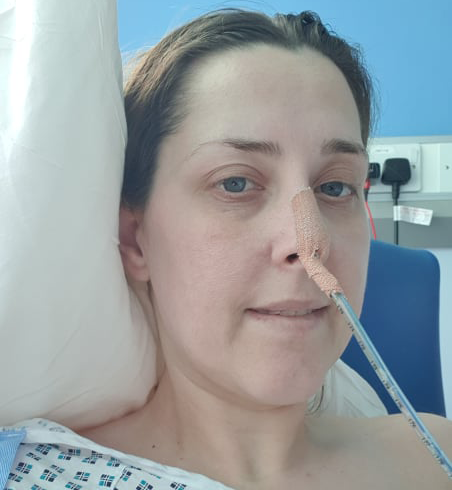
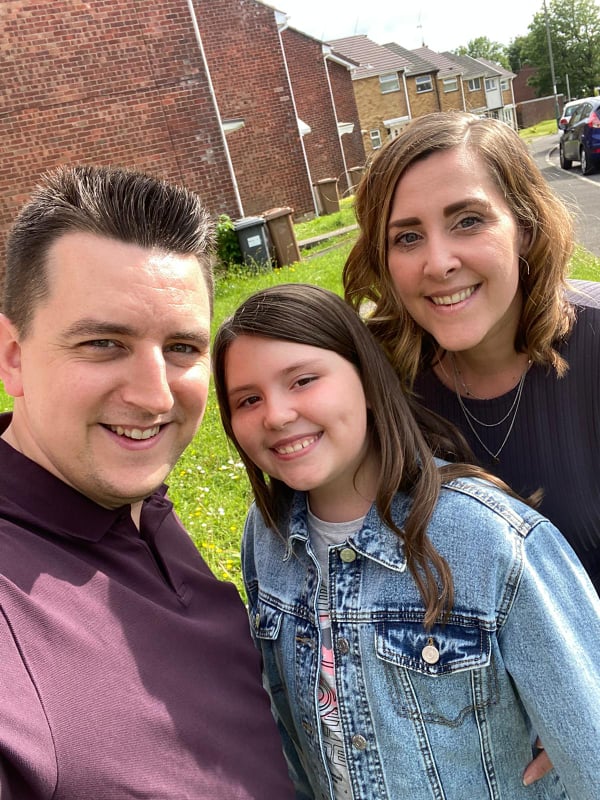
Our latest blog sees the Lemonadies speaking with Jenna, 33. Jenna lives in South Wales with her fiancé, Andrew, and her daughter Mia-Lilly.
Before her diagnosis, Jenna, like 1 in 5 women, wrongly believed that her smear test would detect ovarian cancer.
Jenna: Like most young women I believed a smear test would potentially save my life. I believed that having a smear test would check me for all gynaecological cancers. In fact, I had my smear test only three weeks before I was diagnosed with stage four ovarian cancer. And I assumed my swollen tummy and unbearable stomach cramps were related to having my smear test. I honestly thought I had an allergic reaction to something used during my test.
We’re really sorry to hear this, Jenna. Can you tell us how you received your diagnosis?
Where to begin… I looked nine months pregnant (which was so frustrating as we were trying for a baby). I was constantly tired, swollen, and sick. My appetite was very limited, and I was in a world of pain on every movement. I had been on the phone to the doctors several times over the three weeks and each time they dismissed me, prescribing me laxatives. I wasn’t allowed to be seen due to the pandemic and they told me I should give the medicine “time to work”. I knew deep down there was something more seriously wrong, but I took the professional’s advice and continued with the laxatives, lactulose, and anything I could buy (i.e., prune juice etc.).
Soon afterwards it was my 33rd birthday. I had continued to put on a brave face; I kept those big girl knickers up high and pretended I was ok. But the night of my birthday I struggled to breathe and felt like I was about to collapse. I phoned the out of hours doctors’ number and I insisted I was checked. They sent me to A&E where I was left by myself after my partner was sent away. I was in so much pain – I just sat in the cubicle waiting for the doctor to tell me – what I and all the nurses’ thought was happening – I needed my bowel removed. At 4am I sat on the edge of the bed and a doctor came in with the news I was not prepared for; “YOU HAVE CANCER!”
I was alone, vulnerable, and devastated. How could I tell my family my news? How could I tell the man of my dreams? And most importantly, how could I tell my baby girl that her mummy had cancer?
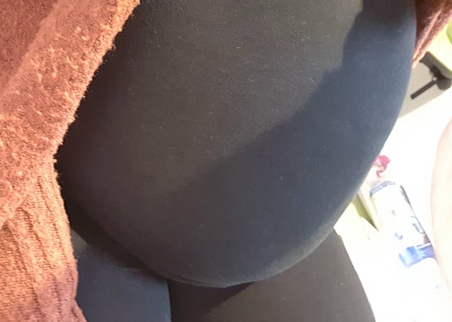
I was then told I had stage four inoperable ovarian cancer and I could call my partner back in to be by my side. Together we cried until 11am until I was wheeled to a private side room. Soon I was drained of ascites fluid (10 litres!) – but at least I wasn’t in too much physical pain anymore.
I was petrified, confused, and felt like my whole world had come crashing down. I saw numerous doctors over the following two weeks of my stay in the hospital and each one told me a different thing. I had biopsies, drains, CT scans and lots of IV antibiotics. I felt like I was no longer me, I felt like I was in a nightmare, and I just wanted to wake up.
I have since had a full hysterectomy, debulking, omentum removal and stomach and bowel stitches. Not only am I now dealing with what has changed to stage three cancer, I am also dealing with my chances of being a mum again being removed. Oh, and let’s not forget I am now dealing with the surgical menopause – nobody can prepare you for that one! It’s not something I thought I would be going through at 33 years old. Night sweats, sleepless nights, and hair loss. I suppose it all prepares me for the next stage – chemotherapy.
I’m so grateful I was operable, and I’m relieved the four tumours have been removed. I realise Some women are not as fortunate. It did come with its struggles; I’m not going to lie. I was extremely poorly after surgery with infections and sepsis. Luckily the NHS staff were all amazing and after nearly four weeks in hospital I was home to recover.
What would you tell other women that are worried that they might have ovarian cancer?
My advice would be if you feel something is wrong do not take their word for it, fight for more tests. Only you know how you feel and when you think there is something wrong make them listen. So often women my age are dismissed as ovarian cancer is uncommon in 30-year-olds, but it is possible – I am living proof! I believe you should stay away from Google. Asking other ladies who have been there and experienced it for themselves for advice is the best way..
Do you have any coping mechanisms you can share with others that might be reading?
Don’t be ashamed to say you’re scared and ask as many questions as you can. Make sure there is always a plan A and a plan B as nothing is ever straightforward with cancer. Get the help when it’s offered and don’t bottle anything up. Explain how you are honestly feeling and never forget how much you have been through. Be kind to yourself and your body as it has battled and will continue battling so much. Be brave and remember there is help available, you just need to ask.
What would you like to see in the future for ovarian cancer awareness?
One main thing in the future I would want is the smear testing age to be lowered and a testing to be made for women to be tested for ovarian cancer with the CA125 blood test. Not only for women with a family history of cancer, but all women. My great nan died of ovarian cancer, but I was never told I could be at risk. There needs to be an increase of information given to women about ovarian cancers. The teal warriors need to be spoken about, remembered, and honoured. All women should be made aware that a simple smear test does not cover you for ovarian cancer and it can develop at any age.
What does the future hold for you?
I suppose just like anyone dealing with cancer we don’t know what the future holds but we will give it an almighty fight. For now, I want to focus on my family, my little girl, and my future husband. Our wedding was cancelled twice due to Covid 19 and now cancelled again due to Cancer. The letter C is not my favourite at the minute.
And finally, Jenna, tell us what’s on your bucket list?
I want to walk down that aisle and make beautiful memories with my family for as long as I can. It’s scary thinking at any minute it could be my last, but I suppose the way we need to look at it is – we are never promised a tomorrow with or without cancer. To anyone reading this, I wish you all the best in your journeys and hopefully in years to come I can come back and tell you my story of becoming NED.
Lemonade would like to thank Jenna for sharing her story and helping us raise awareness. We know you’ll be a warrior during your chemotherapy treatment and we hope you can complete your bucket list.


